October 21st, 2025
The Evolution of Marilyn Manson's Style: From Shock Rock To High Fashion
• The Evolution of Marilyn Manson’s Style: From Shock Rock to High Fashion
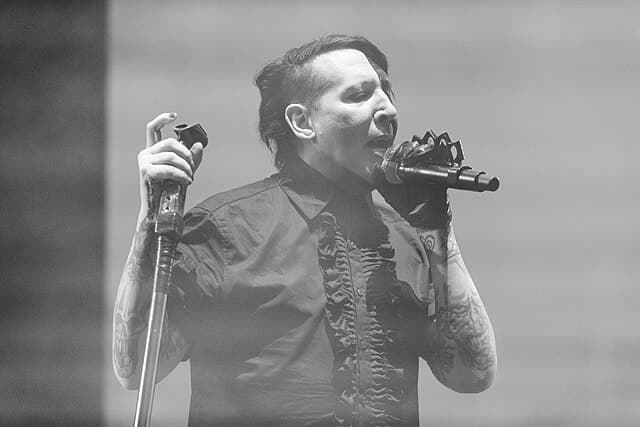
Few artists in modern music history have reinvented themselves as dramatically as Marilyn Manson. For over three decades, Manson has blurred the lines between art, identity, and rebellion — not only through his music but through a meticulously evolving sense of style. Each era of his career has carried its own aesthetic manifesto, transforming him from a grotesque shock-rock provocateur into a darkly sophisticated figure admired by designers and fans alike.
Fashion has always been one of Manson’s sharpest instruments. His wardrobe is performance art — a visual extension of his albums’ concepts. From torn fishnets and smeared lipstick to razor-sharp tailoring and custom couture, every phase tells a story about transformation, alienation, and power. To understand Marilyn Manson’s fashion is to trace his evolution as both an artist and cultural mirror.
• The Birth of a Shock Rock Icon (1994–1998)
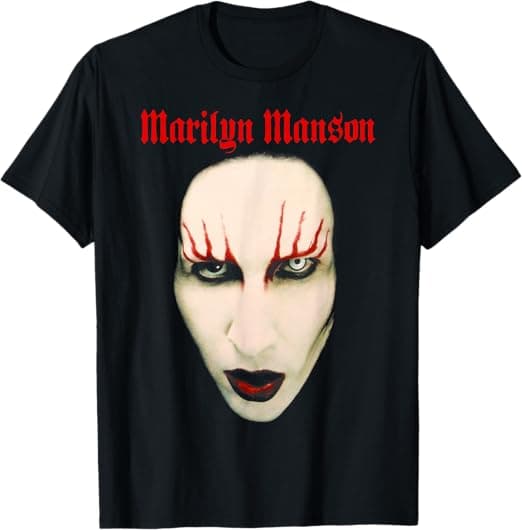
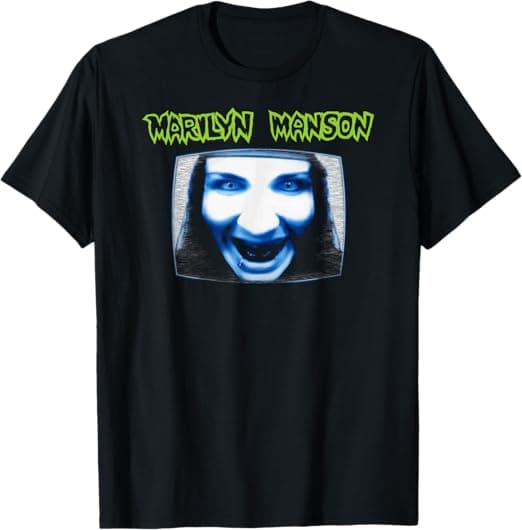
In the early days of Portrait of an American Family and Antichrist Superstar, Manson’s appearance was as confrontational as his sound. He was the anti-hero of 1990s America — pale, skeletal, draped in thrift-store chaos and his signature pair of black rubber pants. Smudged makeup, torn stockings, and menacing contact lenses became part of a deliberate visual rebellion against suburban normalcy. Every look felt like a protest — a grotesque sermon against conformity.
Manson’s appearance during the Dead to the World tour was a carefully constructed vision of decay and dominance. He stalked the stage in shredded bodysuits, black vinyl gloves, and knee-high platform boots that turned every step into an act of aggression. His makeup — ghostly white skin, bruised eyes, and smeared crimson lips — framed a face that looked more like an exorcised icon than a rock star.
For collectors, this era’s merchandise remains gold. Original Antichrist Superstar shirts, tour laminates, and posters capture the unfiltered energy of a controversial artist on the rise — pure, unpolished rebellion preserved in cotton and ink.
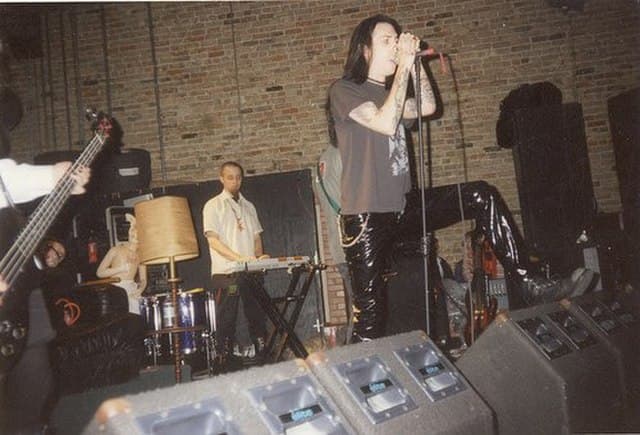
Even in a pair of black rubber pants, Marilyn Manson still looked good.
• Mechanical Beauty and Hollywood Decay (1999–2002)
By 1998, Manson had grown restless. Enter Mechanical Animals — a glam-industrial metamorphosis that replaced grime with glitter. His “Omega” persona emerged: a latex-clad alien, complete with icy wigs and futuristic platform boots. The transformation shocked fans and critics alike. Gone was the chaotic preacher of doom; in his place stood a sleek, gender-fluid glam icon channeling Bowie’s Ziggy Stardust through a dystopian lens.
On stage and in press photos, Manson’s look was metallic and otherworldly — silver bodysuits, translucent skin tones, and a visual palette that glowed under UV light. It was futuristic even by 1998's standards.
But with 2000’s Holy Wood (In the Shadow of the Valley of Death), his style swung in the opposite direction. Out went the alien futurism; in came the sacrilegious soldier. Long leather coats, black military hats, crucifix motifs, and sharp tailoring replaced synthetic glam. The imagery echoed fallen idols and media martyrdom, reinforcing the album’s critique of fame and violence.
For fans, these years mark Manson’s transition from shock artist to calculated storyteller — every fabric choice charged with meaning. Vintage tour merch from this period often mirrors the shift: glossy, futuristic designs giving way to stark, militant iconography.
• The Romantic Goth Renaissance (2003–2009)
The early 2000s saw Manson’s tone soften without losing its theatrical edge. The Golden Age of Grotesque was decadent Berlin cabaret meets industrial decadence — fishnet gloves, top hats, and tailored tuxedos with a dash of Weimar sleaze. He embraced the aesthetics of pre-war burlesque and surrealist art, referencing everyone from Dali to Dietrich.
Then came Eat Me, Drink Me (2007), a period steeped in heartbreak and romantic darkness. The shock gave way to vulnerability, and the wardrobe followed suit. Gone were the latex and armor; in their place came velvet jackets, dark eyeliner, and a sense of wounded elegance. This was Manson’s “fallen aristocrat” phase — the look of a poet who had survived his own apocalypse.
Fans often recall the Eat Me, Drink Me tour as one of his most emotional, and the visuals matched it perfectly: candlelit sets, gothic romance, and a sound that felt almost cinematic. The era’s merchandise carries that mood — muted reds, baroque typography, and imagery that leans more toward heartbreak than horror.
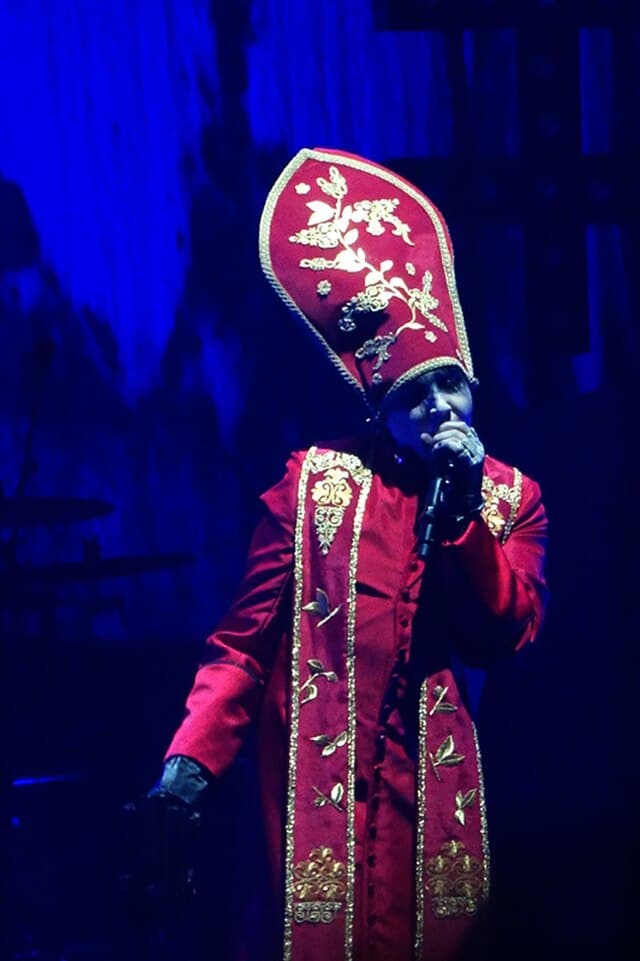
The Holy Wood era marked one of Marilyn Manson’s most visually striking phases, defined by ornate, religiously charged stage attire and theatrical symbolism.
• From Stage Monster to Runway Muse (2010–Present)
As Manson entered the 2010s, his style underwent a mature rebirth. The grotesque theatrics softened into something sleek, deliberate, and timelessly dark. Gone were the overt shock tactics; in their place stood an artist comfortable in his own myth. Black suits, leather gloves, perfectly fitted coats — the style of a gothic gentleman who no longer needed to scream to be heard.
His look evolved into a kind of refined rebellion — less spectacle, more presence. Every detail, from the tailored silhouettes to the darkened sunglasses, carried an aura of mystery and restraint. It was a transformation that turned chaos into control, and noise into quiet confidence.
Manson’s later wardrobe often blended luxury with decay — polished jackets over vintage fabrics, sharp lines contrasted with smudged eyeliner and a flash of crimson on the lips. The contrast was deliberate, a visual reminder that elegance and darkness can coexist in the same breath.
Today, his aesthetic influence continues to ripple through alternative fashion and performance art. The line between stage costume and couture has all but disappeared, replaced by an enduring visual language that balances beauty, danger, and artifice.
• The Cultural Legacy of a Fashion Chameleon
What makes Manson’s fashion evolution so compelling is its refusal to stay still. Each transformation served a purpose: rebellion, critique, vulnerability, reinvention. He used clothing as armor, confession, and provocation — sometimes all at once. His fashion told us who he was before the music even started.
In the ’90s, he challenged society’s fears of the “other.” In the 2000s, he dissected fame and desire. In the 2010s, he became a dark mirror of the very elite that once shunned him. Every outfit — whether a torn fishnet or a tailored trench — played a role in the mythology of Marilyn Manson.
For collectors and fans, vintage Manson merchandise isn’t just nostalgia. It’s wearable history. Each shirt, poster, or accessory holds the energy of a specific era — the anger of Antichrist Superstar, the alien glamour of Mechanical Animals, the heartbreak of Eat Me, Drink Me. Owning a piece of it is like holding a fragment of rock’s most controversial evolution.
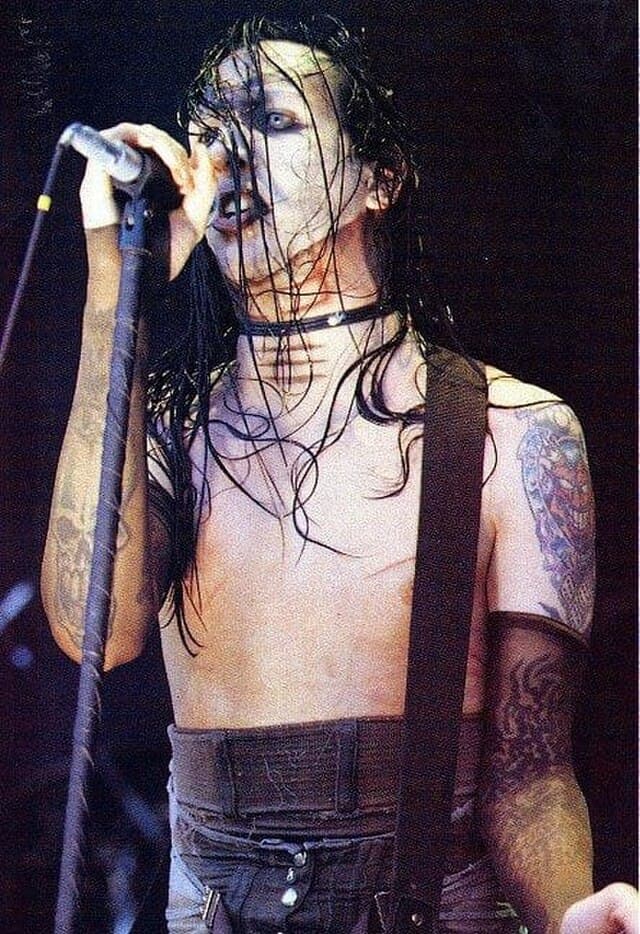
A mix of bondage gear and religious symbolism — Manson’s onstage look blurred sin and style.
• Why It Still Matters
Marilyn Manson’s journey from shock rock to high fashion proves that self-expression and reinvention are the true cornerstones of artistry. His visual metamorphosis redefined what it means to use fashion as storytelling — a language of identity, emotion, and cultural defiance.
To this day, his influence lingers in every leather jacket, every smudge of eyeliner, every artist who dares to be polarizing. Love him or loathe him, Manson reshaped how musicians communicate through image. And for those who collect the relics of his past, those vintage pieces are more than just clothing — they’re symbols of art that refused to apologize.
• Looking for some Old School Marilyn Manson merch?
If there’s one thing every Marilyn Manson fan remembers from the late ’90s and early 2000s, it’s the unmistakable T-shirts that became just as much a part of the culture as the music itself. Whether you were moshing at a Mechanical Animals show, blasting Antichrist Superstar in your bedroom, or just trying to shock your parents, a Marilyn Manson shirt was the ultimate badge of rebellion.
Explore our hand-picked collection of authentic vintage Marilyn Manson merch — from the raw chaos of the 1990s to the sleek darkness of his modern era. Each piece tells a story, just like the man who wore the myth.
Photo by Sven Mandel, licensed under CC BY-SA 3.0, via Wikimedia Commons
Photo by LordLotis, licensed under CC BY-SA 3.0, via Wikimedia Commons
Photo by Patosky1, licensed under CC BY-SA 3.0, via Wikimedia Commons
Photo by Tilt3Kats, licensed under CC BY-SA 3.0, via Wikimedia Commons
Latest Blog Posts
From Antichrist to Alien: How David Bowie Shaped Marilyn Manson’s Mechanical Animals
When Marilyn Manson unleashed Antichrist Superstar in 1996, he cemented his role as the ultimate rock-and-roll villain of the late ’90s. Brutal, chaotic, and nihilistic, the album was a manifesto of destruction—part industrial nightmare, part social commentary, and all rage...
When Marilyn Met Trent: The Florida Meeting That Catapulted Marilyn Manson's Career
Few moments in rock history feel as electric and transformative as the first encounter between two of industrial music’s most notorious figures: Marilyn Manson and Trent Reznor...